
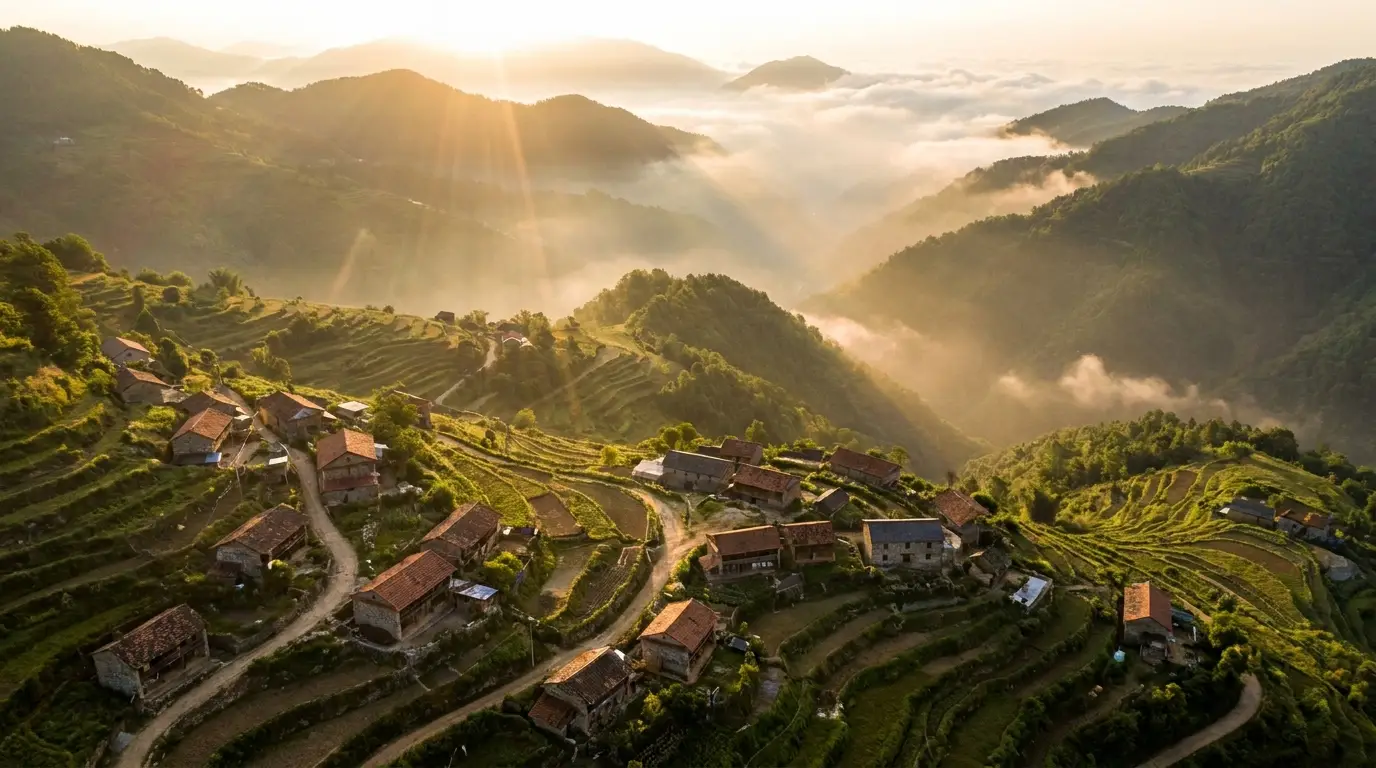
Prompt like a documentary DP
A strong nature prompt has four parts: biome ('old-growth pine forest', 'basalt sea cliffs'), weather and atmosphere ('low dawn mist', 'storm front building'), time of day, and — critically — one thing that moves. Motion is what you're paying for in video: drifting fog, waves detonating on rock, grass rolling in wind, a flock lifting off. A prompt without a named motion event tends to produce a beautiful but inert postcard.
Layer the frame for depth. Foreground elements — ferns, spray, branches crossing the lens — give the camera move parallax to reveal, and a scale cue like a distant bird or tiny tree line makes the landscape read as vast rather than miniature.
Light and weather are the real subject
The same valley is five different shots depending on conditions, so treat weather as the creative decision. Fog compresses a scene into soft layered planes; a storm gives you contrast and drama; post-rain sun saturates every green in the frame. Prompt the atmosphere with the same care you'd give the subject — 'volumetric light through mist' does more for a forest shot than any adjective.
For rendering quality, Veo 3.1 is the premium-realism pick when foliage detail and water behavior need to hold up full-screen, and Veo 3.1 Lite delivers most of that realism at a friendlier credit cost for volume b-roll. Kling Video is a solid mid-tier default for landscape work.
Camera moves that fit the genre
Nature footage has its own movement vocabulary, and Nidhogg's camera presets cover it: DRONE PULLBACK for the scale reveal that opens a sequence, SLOW ZOOM for the patient observational feel of documentary work, FLYTHROUGH for terrain, and SKY TIMELAPSE for cloud movement over a static landscape. LOCKED OFF — a motionless tripod frame — is underrated here; it reads like a camera left quietly at a hide.
Match energy to subject: fast FPV moves suit canyon and coastline adrenaline pieces, while wildlife-adjacent and meditative content almost always benefits from slower, longer moves that let the atmosphere breathe.
Where these clips go to work
Ambient and meditation channels use generated nature loops as continuous visual beds; documentary and educational editors use them as establishing b-roll between talking segments; brands drop them behind title cards where licensing real aerial footage would blow the budget. Because every clip starts from text, a series can stay in one coherent visual world — same biome, same weather logic — across dozens of assets.
Finish for the destination: reframe converts a 16:9 master to vertical for Shorts and Reels, and video upscale sharpens clips headed for large screens.